
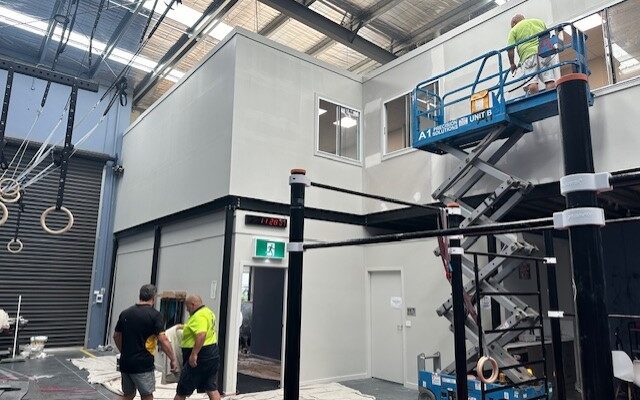
Scissor lift in a warehouse working on the exterior of a mezzanine office.

Is A Mezzanine Office Right For Your Business?

Different businesses have different needs. And because of that, different businesses have different operational setups, including how their office is set up.

For businesses that have a warehouse, there are even more options when it comes to operations. Some warehouse based businesses have a separate dedicated office area that may be attached to the warehouse or even offsite. Other’s require an office within in the warehouse; this can be a small area of the warehouse or an enclosed space in the warehouse itself. Other businesses have a combination of this. For a lot of businesses, they may have a dedicated office where customer service and accounts team work while the warehouse may have a small office for logistics and organising.

As mentioned, for a warehouse based office, there are a lot of options.

One of these options is a mezzanine office in a warehouse. This is exactly what it sounds like. Warehouse mezzanines can be used for a lot of things, and one of these things is an office. When customers come and speak to us about a warehouse mezzanine, they often want it for storage or to create another working area for warehouse staff. However, often times, it’s more efficient to move an office area to the mezzanine and use the space saved for something else.

All in all, that’s the benefit of having a mezzanine office in a warehouse.

Although using a mezzanine for storage or other warehouse operations can be beneficial, one drawback of this is that the goods stored on the mezzanine are now at height, and there’s a logistical burden of getting them down. This can be done with a forklift, conveyors, or just with warehouse workers but there may be an inefficiency here. An office, on the other hand, has less movement of people up and down. Office workers get to their desk and they stay there.

Meanwhile, important warehouse floorspace is saved and can be used for something that is better suited to ground level.

This is all about general warehouse optimisation. There are circumstances where it’s more convenient to use a mezzanine for storage, but much of the time it’s best to keep storage at ground level if possible, with operational elements like offices above ground on a mezzanine.

Other ways a mezzanine office can be used is by creating a second level to a warehouse office. Mezzanines work well as semi-permanent structures because they’re self supporting and don’t need to be attached to the base structure, making them easy to remove at the end of a lease during make good time. In this way, an office can be constructed on the ground floor, with a mezzanine built above it house more office space. This is a perfect way to create a large office area in a warehouse without taking up too much valuable storage space.

If you’re looking at expanding the office space in your warehouse, speak to us as soon as possible. We’re happy to advise on options available.
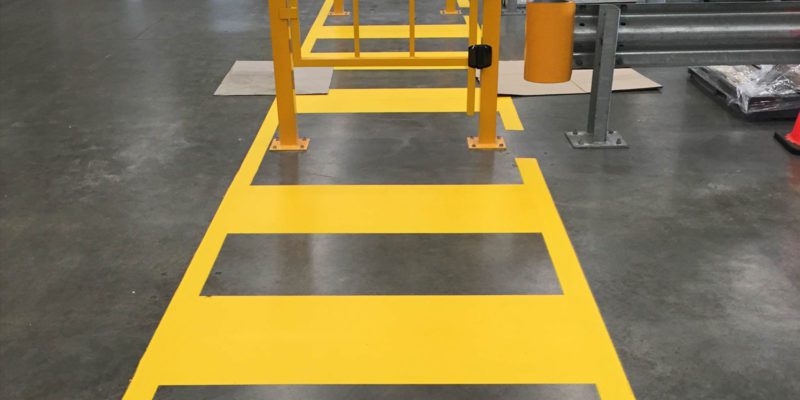
Line Marking and Safety Barriers

How’s Your Line Marking?

Safety always needs to be the highest priority in the workplace, especially in an industrial setting like a warehouse or factory. One key safety feature in warehouses and factories is line markings.

Line markings are a basic but essential safety feature in industrial settings.

On aspect of line marking and safety is to keep areas separate and/or alert people of shared areas. Warehouses, for example, inevitably have materials handling equipment like forklifts in operation. This poses a significant safety risk for pedestrians in the warehouse. Line markings can be used to designate pedestrian only zones, forklift only zones, and shared zones. Although line markings such as this don’t guarantee safety, it’s one of the many features that can be put into a warehouse that help with safety.

Line marking can also be use to designate specific areas in a warehouse such as parking, loading, unloading, and temporary storage. Not only is this good for organisation, order, a warehouse optimisation, it also promotes safety by making sure everything is where it’s supposed to be.

It’s Easy To Forget About Line Marking

All that being said, it’s easy to forget about line marking and let it deteriorate.

Like everything in a warehouse or factory, line marking is subject to wear and tear, and needs to be maintained and replaced over time. With people and equipment moving over it everyday, line marking will wear out and will need to be repainted. But, as mentioned, it’s easy to forget about this.

Since the wear happens slowly, people who are in the warehouse every day simply won’t notice the fading and, over time, line marking loses its brightness, contrast, and therefore effectiveness. It’s a gradual process that’s easy to ignore until the markings are gone and no longer doing their job.

Every workplace should have regular safety audits and evaluations. Warehouses are already used to yearly pallet racking inspections, and should be doing their own safety assessments regularly. These assessments should include looking for damage to pallet racking, safety barriers, signage, and of course, line marking.

An assessment of line marking could include keeping records of when line markings were last painted, looking for worn areas, and comparing pictures of the new line marking compared to how it is now. Have a threshold for when line marking needs to be redone and stick to it.

Let’s Talk Line Marking

So, when was the last time your business had its line markings repainted? If you can’t remember, go out onto the floor and look at it. How worn is it? Do you think it’s still doing its job? Or does it need to be re-painted?

Come and talk to us about your line marking and other warehouse safety needs. We’re happy to help.

Reception area for a clinic.

Office Fit Out Essentials

When planning a new office fit out, it’s easy to focus on the core aspects of what makes an office an office. Here we’re talking about things like desks for employees, reception area, meeting rooms, and maybe a few private offices for management. Because of this, it’s easy to forget about other essentials that lead to a better and more comfortable office environment. Getting these elements right keep employees happy and more productive.

So when you’re planning your next office fit out, don’t forget to plan and budget for the following.

Breakout And Collaborative Spaces

Some industries will need more breakout spaces than others, but pretty much every office needs areas that allow for collaborative work or work that simply can’t be performed at a personal desk and computer. This may be as simple as an area where colleagues can have an informal meeting to discuss a project or client without having to find a free meeting room.

For some industries, employees occasionally need to spread out, and having space to do that is important. Here at A1 Precision Solutions, we’re often dealing with large plans and architectural drawings, so providing an area to work on these things is important not only for employees, but the general running of the business as well.

Kitchen And Break Areas

Employees need to take breaks, and when they do, it’s important to provide them a place where they can recharge comfortably before getting back to work. That’s why having good kitchen and break areas is so important.

Kitchens and break areas are often overlooked. Sure, good employers want to make sure team members are comfortable, so they concentrate on where they spend most of their time: at desks and in work areas. And through this, they cut corners so kitchens and break areas because they’re used less. However, a good break area makes it so the team gets a better break and gets back to work more rested and better able to concentrate. Good amenities in the kitchen like a coffee machine, ample food storage, and more keeps workers happy and productive.

Outdoor Areas

Similar to the kitchen and break room, it’s easy to forget outdoor areas, especially because they’re potentially used even less, especially in winter. However, even if they’re not used frequently, having a great outdoor area that’s comfortable and well maintained can be very valuable on days when the sun is shining and the air is warm.

And an outdoor area can be simple. All you need is a picnic table, a few plants, and a gardener to maintain it from time to time. From there, the outdoor area becomes a good lunch spot on sunny days or a nice place for an informal meeting that’s productive but also refreshing.

Bathrooms And Toilet Areas

Amenities like bathrooms are also easy to overlook. All businesses ensure their bathrooms are clean and functional, but they don’t do much more. These are areas that are high traffic and can suffer from a lot of wear and tear. With that, if you get bathrooms wrong, they may not feel clean or comfortable for employees, which may cause loss or morale.

Because of this, being careful in planning for these amenities, and perhaps allocating a bit of extra budget here to make the bathrooms more premium, can go a long way.

Get Planning Early

If you’re considering a new fit out for your office, or if you’re moving offices and need to a fit out for your new premises, let’s talk. Planning an office fit out takes time, so it’s important to engage with companies like A1 Precision Solutions early. This way we can talk about your goals for the new office, find out what’s required, help figure out a reasonable budget, and ultimately get to work.

Person welding together two large I beams.

What Can I Fabricate?

We’re a full service commercial construction company, and one of those services is custom fabrication. It’s not a service that we talk about a lot, but it’s an important part of our business. One main reason we don’t often talk about custom fabrication is because it’s part of almost every aspect of our business, which means we often take it for granted. A lot of pallet racking is works well for many different businesses, but for some businesses, it needs to be modified by our custom fabrication team. This is the same for our mezzanines.

But beyond modifying pallet racking and mezzanines, what else can be custom fabricated?

The simple answer is almost anything can be custom fabricated.

As mentioned, we’re a commercial construction company, so we mainly specialise in modifying pallet racking or custom fabricating mezzanine levels. This includes fabricating things like stair cases for mezzanines and safety features for unique pallet racking situations. Beyond these jobs, we also custom fabricate other items for commercial premises, whether those are custom display stands, racking for cars and art, industrial doors, and more. There’s very little that our custom fabrication team can’t make.

All that being said, A1 Precision Solutions mostly concentrates on custom fabrication of bigger things. We offer all aspects of the custom fabrication process including CAD, cutting, drilling, bending, forming, and welding, but because we’re a commercial builder, we tend to fabricate things for commercial building projects, not small objects or product prototypes.

But that doesn’t mean that we can’t make it if a customer thinks of it. A good fabricator always has a solution to a challenge. We’ve made everything from custom steel frames for a building all the way to safety gates for a factory. Although there is often an “out of the box” solution that doesn’t require custom fabrication, sometimes the unique needs of a business mean custom fabrication is the best option to solve the problem.

All in all, we often get the question from clients on whether we can custom fabricate something. The answer is usually “yes, but…” We say this because, as mentioned, there’s usually a standard product that would work just as well (if not better) while also being less expense and faster to produce. For other projects, there just may be a need to modify a standard product rather than make something completely custom.

All in all, custom fabrication is a great option, but it shouldn’t be the first option. Because of this, it’s important to speak with experts about the challenges your business is facing, and exactly what needs to happen. From there, we can suggest a number of options that will get the job done. This may include something standard, a modification, custom fabrication, or a combination of all three.

Speak to us if you’d like to know more.

Installation of sandwich panels in a cool room.

The Many Uses Of Sandwich Panels

Sandwich panels are a versatile building material that have a variety of different uses and applications in commercial construction. They’re used in a lot a different places and have a lot of advantages over other more traditional building materials.

So let’s explore the different ways sandwich panels are used in construction.

But first, what exactly is a sandwich panel? A sandwich panel is made up of an internal layer sandwiched between two rigid outer layers. Although sandwich panels are usually quite rigid and strong, they’re typically not strong enough to be load bearing. Sandwich panels are made out of a lot of different materials, depending on what they’re being used for, but typically the internal material is expanded polystyrene, mineral wool fibre, or similar.

Sandwich panels have excellent insulation properties and are often fire rated, so their uses often fall into applications where this is important.

Cold Storage

Because of their insulating qualities, sandwich panels are often used in cold storage facilities.

These facilities are usually very large and contain pallet racking, storing goods on pallets. This is why sandwich panels are used instead of other building materials when creating cool rooms and other cold storage facilities. Sandwich panels are relatively light weight, fast and easy to install, and provide the level of insulation required to keep the facility cold.

Processing Facilities

Since sandwich panels provide excellent insulation, they’re also good for use in facilities where a relatively steady temperature is needed (even if temperature control isn’t needed). So, in the same way that sandwich panels work well in cold storage facilities, they also work well in general processing facilities.

The other benefit of using sandwich panels when building processing facilities is that they’re easy to clean when needed. They’re also easy to install and also take down when it’s time to do an end of lease make good.

Fire Resistant Areas

Many sandwich panels are also fire resistant, which means that they can be used in areas that require a fire rating. This can be in processing areas or areas that have a high risk of fire. If a fire does occur in these areas, a fire rated sandwich panels can slow or even prevent the spread of a fire in an industrial facility.

Like other uses of sandwich panels, using sandwich panels in places that need fire resistance has the added benefit that the panels are often quick and easy to install, often saving time and money in the construction process.

Roofing And Facades

Sandwich panels are also very useful in the use of roofing and facades. As mentioned, these panels are fast and easy to install, and they’re also water tight, making them ideal to used in outdoor areas. Then, of course, since sandwich panels have excellent thermal insulation, they’re ideal for facades and roofing in order to help keep building warm in the winter and cool in the summer.

However, as mentioned, sandwich panels often aren’t good for structural use, which is why they’re often only used for facades rather than for load bearing walls.

Talk To Us About Your Next Project

Sandwich panels are extremely versatile and can be used in a variety of ways. If you have a project coming up that may have use for sandwich panels, get in touch with us. We’d be happy to provide advice.

Can A Warehouse Mezzanine Be Moved?

A mezzanine floor can be very handy in a warehouse situation. It can be used for additional storage either above or below it, for office or staff space, shelving above pallet racking, and more. Overall, a mezzanine is an extremely versatile addition to a warehouse. But what happens if the mezzanine needs to be moved or removed? Is it permanent?


The short answer is that warehouse mezzanines can be moved or removed if needed; they’re only a semi-permanent addition to a warehouse in most cases.

There are a lot of reasons why a business may need to move a mezzanine, so making them only semi-permanent is ideal.

Since many businesses rent their warehouse space, a mezzanine may need to be removed at the end of a tenancy as part of the make good process. The owner of the warehouse may not want the mezzanine present, so it may be required to be removed prior to vacating the warehouse at the end of a tenancy.

The good news is that once the mezzanine is dismantled and removed, it may be possible to move it to the new business premises and be used again. Many mezzanines are built in a modular fashion, so they can be rebuilt and added to if needed.

With that, although most businesses are happy with their mezzanine’s position, changes in business needs may mean that the warehouse needs to be reorganised and the mezzanine may need to be moved to a different part of the warehouse. Again, this is easily possible.

All of this is possible because, as mentioned, mezzanines are built in a modular fashion. For many of the mezzanines that we build at A1 Precision Solutions fabricate most of the mezzanine off site, and then put it all together onsite. This speeds up the building process and limits the downtime a business sees when installation is happening. In addition to this though, since a mezzanine is something that is “put together” it can also be taken apart and put back together again!

All in all, getting a new mezzanine for a warehouse and then moving or removing it later is quite simple. If you need more space in your warehouse, a mezzanine may be a good answer. Speak to us today about what we can do for you.