Glazed Office Partitions

Moving Office Checklist

Whether it’s because of growth, the end of a commercial lease, change in needs, or something else, many businesses will move offices in their lifetime. Although it can be inconvenient to the business, managers, employees, and customers/clients, ultimately an office or business relocation can be beneficial for everyone. Moving offices gives give the opportunity to have a new modern office fit-out, create more space for everyone, and streamline operations with something created completely fit for purpose. All in all, the inconvenience of an office relocation can be outweighed by the long term benefits.

To make your office relocation easier, we’ve created a short checklist/guide on what to expect and what to plan for when moving your business. This list isn’t necessarily exhaustive, of course, as all businesses will have different needs and challenges. Use this checklist as a guide to expand and plan your move.

3-6 Months Before The Office Move

While a lot should be happening a year or more prior to your office move, things really start to get busy 3-6 months before the move. A year prior you should have scoped out (and found) new office space and began working with a builder on an office fit-out. Now it’s time to figure out how you’re going to be leaving your office.

Things to do and consider around this time include:

Notifying internal and external parties: ideally employees will know about the upcoming move as early as possible, but about 6 months in advance is a good time to give them firm dates, plans, and timeline ideas for the next 6 months. This is also a time to notify any external parties of your move, making sure you give plenty of notice for services that may require them. Remember services like:

  • All utilities, including internet and specialised IT services, making sure important IT infrastructure and data isn’t lost in the move.
  • Services such food/water deliveries, office plants, stationary deliveries, etc. These services may require a notice period to cancel them or relocate them, so start early.
  • Keep clients across the move as well. They’ll need a reminder closer to the date, but it’s good to let them know what’s going on.

Engage with an office relocation specialist: office and business relocation specialists like us here at A1 Precision Solutions are used to working with tight timelines, but the early you can engage with use, the better. The extra time allows for extra planning and making sure nothing is forgotten.

Start planning your make good: when finalising a commercial lease, the vacating tenant will likely have make good obligations. Make good obligations are what the vacating tenant needs to do to ensure the property is left in a suitable state for the landlord. This may involve simply removing fit-out items like partitions or it may include stripping the building back to its base. It’s important to review your commercial lease, understand what needs to be done, and engage with a builder to plan your make good.

0-2 Months Before The Office Move

Obviously a lot is going to happen in the 3-6 month period prior to the move, but if you engage early with professional office relocation specialists and make good specialists, they’ll guide you through the process. These are the two biggest parts of an office move, after all, and engagement with specialists will help you create further check lists that are unique to your business.

So, as moving day approaches, you need to ensure the following:

Make sure the fit-out of your new office is on track: you don’t want your employees and business to be without an office, so it’s important to make sure the fit-out for your new office is on track. If it’s not, it’s important to create a contingency plan whether that means pushing back your move out date, creating a temporary working from home option, or finding short term office space. This will all depend on the way your business operates as well as the terms of your lease.

Ensure utilities will be ready in your new space: it’s always easy to forget utilities, so make sure they’re ready to go in your new office space. As mentioned when discussing shutting off utilities, pay special attention to IT infrastructure and how it will rollover between the two premises, especially if it needs to be always on and is business critical. This may also mean communicating with customers on expected downtime.

Start packing early: recognise what can be packed up early and pack it, moving it to the new office if possible. While you obviously can’t start packing up work stations until the very end, things like paper records that need to be kept for legal reasons (but are very infrequently accessed) can easily be packed and moved, relieving stress on moving day. Use this as an opportunity to go over the plan for moving day as well.

Communicate with employees: a few weeks before the move, it’s important to communicate with employees what their obligations will be on moving day; we’d suggest doing this verbally in a town hall style meeting as well as in writing with clear instructions they can follow. What employees are obligated to do will depend on the office set up, but it may include them packing up parts of their workstation themselves, taking personal items home, or just a general tidy.

Communicate with customers: although you should have communicated with customers months prior, it’s also important that you remind customers of your upcoming move a few weeks beforehand. Although your office move will likely go well, it’s important to let customers know there may be some communication delays (whether planned or unplanned) in order to pre-empt any problems.

And Don’t Forget The Fit-Out Of The New Office

This article only briefly touched on planning the fit-out for the new office. This is a topic all in its own that we won’t go into here. What we will say though is that A1 Precision Solutions is a true end-to-end commercial construction firm. This means we can handle the fit-out of the new office, the make good of the old one, and the move in between. This allows clients to only have to work with one provider, not having to worry about coordinating three. Feel free to contact us regarding your office move. We’re happy to help.

Temperature Controlled Cleanrooms

How To Prepare For A Make Good

When ending a commercial lease, whether it’s an office lease, retail lease, warehouse lease, or something else, it’s typical for exiting tenant to have make good obligations. Basically speaking, make good obligations require the exiting tenant to leave their old premises in a certain state. This may mean simply leaving the old facility in a neat and tidy manner, it may be repainting and repairing elements of the building, or it may be as large as removing all fit-out elements of the facility and returning the premises to its empty base state. It can really very between buildings depending on the state of the building before the tenant moved in, the landlord’s requirements, what modifications were made to the building, and much more. All that being said, the make good requirements will be outlined in the commercial lease and will have been agreed to prior to commencing the lease.

So, although you may be relocating your office, it’s still important to consider your old office is left in a good state. This is to avoid fees and repair charges from your old landlord. Fortunately, preparing for a make good isn’t that challenging and, with the help of a company like A1 Precision Solutions, we can make sure it goes smoothly.

Understand What’s In Your Lease

Before commencing your make good, it’s important to understand what the make good actually requires.

As mentioned, make good requirements can vary, and what actually needs to be done will be outlined in your commercial lease. Because of this, it’s best to start with the lease to see what is needed.

If your facility has limited fittings and make good requirements, you may only need to remove the furniture and leave the building in a neat and tidy state. If that’s the requirement, just arrange office movers and you’re likely finished.

However, it’s more likely that your business will at least be responsible to repair any damage done to the building over the course of the tenancy.

Bigger make good requirements may include removing any fit-outs that were installed during the tenancy. This may include office partitions, signage, and even carpeting if that’s what’s specified. Going further, make good requirements may even require a full strip out, getting the building completely back to its base.

As mentioned, all of this will be outlined in the lease.

Make A Checklist Of What Needs To Happen

To stay organised, it’s important to make a list of what needs to happen to complete the make good. Assuming your business is relocating, it’s likely there’s already a checklist relating to the actual move. Just make another pertaining to the old location.

Generally speaking, make good tasks will fall into three broad categories.

Removals: these are things that need to be removed. Furniture is the obvious one here, but it may also include things like carpet and office partitions.

Repair: it’s inevitable that parts of the building may be damaged over the life of a tenancy, so having a list of what needs to be repaired can be handy.

Restore: restoring parts of a building, whether that’s through restoring a building back to its base features or something else, will be a large element of the make good.

If you talk to a professional make good company like ours, we can help you with what needs to be accomplished.

Speak To Your Landlord

Once you have an understanding of what needs to be done, it’s usually a good idea to have a pre-inspection/pre-make good walk through with your commercial landlord or their representative. Here you can go through your checklist and outline what will be completed in the make good process. This is an opportunity for your landlord to see what you’re intending to do for your make good obligations and request any further work, should it be needed. In this way, you can ensure no further repairs or alternations will be needed after your make good company finishes work.

Get A Reputable Make Good Company

A good company that is experienced in make good obligations can help you and your business manage all of this, ensuring you can concentrate on moving into your new premises. Get in touch with us early to make sure everything goes to plan.

Large amount of pallet racking in a warehouse.

How To Prepare For A Pallet Racking Inspection

If you run or have a warehouse, you likely have pallet racking. Pallet racking is a great warehouse storage tool. When used correctly, pallet racking can make storage easy, fast, and dense. It can also be very safe for warehouse staff and visitors.

However, if not maintained or used properly, pallet racking can pose a danger. Pallets can fall from racking or it can collapse due to unmitigated damage. Because of this, according to AS4084:23, pallet racking needs to be properly inspected every 12 months to check for damage or anything else that needs to be fixed. A pallet racking inspection needs to be done by a professional who will then give you a report on what needs to be rectified; once any problems are fixed, your pallet racking is certified for another 12 months.

When we book a pallet racking inspection for clients, they often wonder what needs to be done to prepare for it. Assuming your warehouse is operating safely, the short answer is that there isn’t much that needs to be done to prepare. However, if you’re unsure, there are a few considerations you may want to make before your upcoming pallet racking inspection.

Make Sure Your Warehouse Is Safe

Safety should always be the highest priority in a warehouse, and safety issues should always be addressed quickly. That being said, it’s also easy to become complacent over time. Although pallet racking inspectors aren’t there to find and report general safety concerns, an upcoming racking inspection is a good opportunity to go over any safety problems in your warehouse.

This may include checking fire safety devices, clear exits, and the general tidiness of your warehouse.

And Yes, Tidy Your Warehouse

A clean warehouse is a safe warehouse.

During your racking inspection, the inspector will need access to all of your pallet racking to check it for damage. This means that everything needs to be accessible. If some or part of your pallet racking isn’t accessible or can’t be seen by the inspector, they may not be able to finish. And if they can’t finish, they can’t certify your pallet racking as safe for another year.

Make sure your warehouse is clean and tidy so that the inspector can do their job quickly and let you get back to yours.

Rectify Any Pallet Racking Maintenance Issues

Ultimately, if a racking inspector finds a safety issue with your pallet racking, such as damage, you’ll be required to fix it before the pallet racking is certified. If you’re already aware of a problem with your pallet racking, get it fixed before the inspection. This will mean there’s less to do after the inspection and you can get certified quickly.

Going further, it also means that you can get your pallet racking fixed in your own time. For example, if there’s a problem with your racking that requires it to be unloaded, this can cause significant disruption to your business. It’s better to do this with the right planning rather than haphazardly after an inspection.

Other Than That, Operate Like Normal

A yearly pallet racking inspection isn’t designed to catch anybody out or get anybody in trouble. It’s designed to make sure pallet racking is safe and to prevent workplace injuries. With that in mind, pallet racking inspectors are there to help. If you’re unsure about how you should be using your pallet racking, ask your inspector. They can give you advice, get your pallet racking fixed, or even suggest alternatives to make your business operate more efficiently. Operating as normal will help your inspector see what needs to be changed.

If you need advice on pallet racking, or need to arrange an inspection, get in touch with us today.

Man installing office partitioning

When Is The Best Time For An Office Renovation

Renovations and remodels are a fact of life, generally speaking. Sure, it’s not something that a business goes through every day, but whether it’s the office or the home, updating and renovating is something that needs to happen from time to time. People like to get their spaces updated and modernised because we want something new and different, we don’t want old technologies, and we also want to fix general wear and tear issues. This is the same with an office renovation. It’s important to modernise to keep the business looking good to customers, and to just keep ahead of maintenance issues.

All that being said, renovations can be inconvenient. Even when they’re completed quickly, there’s always a period of having to live through renovation. This may mean a meeting room is out of action for a couple days, employees don’t have as much space as they’re used to, and even temporary shut offs to utilities. And when it comes to utilities, even if the power is off for only an hour, it can really disrupt a business.

So all of that raises the question: when is the best time for an office renovation? This could mean when is the best time of year, or when is the best time for a business in general? Let’s take a look.

Consider Your Business Cycle

Ultimately, the most important thing to consider when doing an office renovation is how it will impact the business. With this in mind, consider the business cycle and how you can fit an office renovation in. All business have slow seasons, so obviously it’s best to try and schedule your office renovation into a time period when you know business is going to be slower.

Be wary, however, of times like Christmas holidays, where many service based business may be slow. During these periods, many commercial construction companies will have shut down periods or, at the very least, be working with few staff members due to people taking holidays. This may delay a project.

Going further, when planning your office renovation, make sure you start planning well before your intended renovation period. Planning and designing take time, as does sourcing and shipping materials for a renovation. If you’re hoping to start an office renovation during a quiet time for the business, you may need to start planning and engaging builders months in advance.

Consider Staffing

This goes for both when the best time for a renovation is and in general.

Office renovations may start to come up when employee needs change. Renovations aren’t just about the look and feel of an office, but some of the other conveniences like restrooms and kitchens. As a small example, if the office headcount grows to the point where the office kitchen is overcrowded and there’s no room for anybody’s lunch in the fridge, it may be time for a renovation. It may be time to move to a new office as well, but that’s another story.

Many businesses have natural staffing fluctuations, whether it’s taking on more people at a certain time of year, or a time when there’s a lot of staff away. If it’s the former, it’s probably a good idea that renovations happen before a large induction of new staff. If it’s the latter, try to schedule your office renovations during times of fewer staff.

Going further, if you can temporarily shift staff to working from home or at an alternative site, this could also be a good option to minimise disruption to the staff as well as the construction workers trying to get your new renovation done.

Consider Replacement Furniture, Fittings, And More

We touched on this before, but it’s important to consider lead time for construction material, as well as furniture and fitting. Because of this, when trying to decide if it’s time for an office renovation, consider what the condition of your most used furniture is going to be in a year. If you think furniture may need to be replaced now, it will definitely be completely worn out in a year. This means it’s time to start planning your renovation, speaking with designers, and getting quotes from builders. You won’t be in complete renovation mode for a whole year, but by the time everything is done, 12 months will have passed.

Get Some Advice

Feel free to contact us if you’re considering an office renovation. The planning process can take a long time, so it’s best to engage a builder early.

Office Fit-out

Why You Need A Professional To Do Your Make Good

When a commercial lease is finished, it’s usually the obligation of the departing tenant to return the building back to its original condition. This is what’s referred to as an end of lease make good, and it involves removing all furniture, fixtures, fittings, and modifications that may have been installed by a commercial tenant.

When a commercial tenant moves into a premises, it’s often given a basic and empty building: it’s a shell. The business can then make modifications to the building as needed. It may paint it to suit its brand, install features that are needed for its business operation, and even put up walls and partitions so it can use the building as it’s needed. When a lease is finished, the old tenant is expected to remove these things.

Usually make good obligations are outlined in the commercial lease. That is, what the tenant is expected to do, what it doesn’t need to do, and any other agreements around finalising the commercial lease and returning the building back to its original state. Of course, this may include negotiations with the landlord that allow the tenant to keep some of the modifications in place without having to pay to remove them.

But generally speaking, a commercial contract will outline that a tenant can either settle with the landlord for a fee, making it the landlord’s responsibility to return the building to its original state; or the tenant can complete the make good themselves, either organising their own tradespeople or using a professional commercial builder to complete the end of lease make good.

For a lot of businesses, they may find simply settling with the landlord the most convenient option. There are a lot of things to do when relocating a business, and the last thing an operations team wants to do is try and get their old premises back to its original state. Settling with the landlord is a fast and easy option, and one that may be suitable if there’s more budget than there is time and other resources.

However, for businesses that choose to organise their own end of lease make good, there is the opportunity to save a lot of money, and if they hire a builder to do the work, save just as much hassle as settling with the landlord.

A business’ operations team may think the only way to save money on make good obligations is to organise all aspects of the make good themselves, but this simply isn’t true. Settlements with the landlord are always going to be in the landlord’s favour, so it’s generally going to be the most expensive option when it comes to finalising a commercial lease. Of course money can be saved by a business managing a project themselves, using a commercial builder is still going to be a less expensive option than settling with the landlord.

If your business is going to be ending a lease soon, it’s worthwhile talking to us to find out how we can help with end of lease make good obligations. You may be surprised at how reasonable it all comes to.

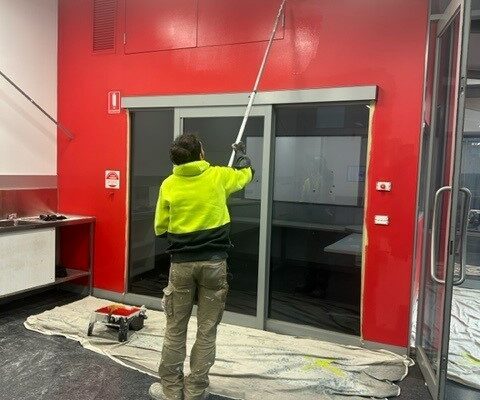
Man painting a wall red.

What Is Turnkey Construction?

When it comes to construction projects, they can be delivered in a variety of ways. Sometimes a client has a design already done and just needs a builder to build the project to specifications. Other times, the client needs everything done; a true end-to-end construction project. This is turnkey construction.

Here at A1 Precision Solutions, we pride ourselves on being a turnkey commercial construction company. While we can (and do) deliver projects designed by clients, for most clients, we do the full design work, seek permits, and build the project. The project is delivered ready to use, with very little (if anything) left to do for the client. All the client needs to do is come to their facility at the completion of the project, open the door (i.e. turn the key) and get on with running their business.

What’s Involved In A Turnkey Construction Project?

As mentioned, a turnkey construction project involves completing all aspects of the project for the client. Construction projects aren’t just about building something, they’re also about planning, designing, seeking permits where appropriate, building, and actually managing the build itself with project managers.

An example of a turnkey construction project would involve an office fit-out. An office fit-out may involve stripping or de-fitting the old office, painting and installing new carpets, installing new fixtures, and finally moving in and setting up all the office equipment. It would also involve making sure all utilities are installed and work as needed. In some cases, if the building’s purpose is being changed, permits may also be required. Throughout all this, planning and management is also needed.

Basically, an office fit-out isn’t just putting some desks in and calling it a day, it’s creating a new workspace that’s fit for purpose. A business that’s seeking a new office may be very good at what they do, but they’re not experts at creating new workspaces. We are, and that’s why our clients rely on us to take care of every aspect of a fit-out project.

What Are The Advantages Of Using A Turnkey Construction Firm?

Using a turnkey construction company means that, as a client, you don’t have to manage anything. We collect a brief from the client, design the project, complete the project, then hand it over to the client. The advantage here is that the client can be confident that everything is taken care of and nothing is forgotten.

If a client attempts to cut corners and manage a project themselves, important aspects of the project may be missed, leading to complications in the future. For example, a client may assume that the building they’re moving into has the electrical infrastructure in place to support their business; this assumption can be disastrous if the client gets it wrong. 

While it may sound expensive to leave the full management and production of a project to a third party, in a lot of ways, it’s no more expensive and can even save a client money. Think about it, design services and engineers need to be paid for, whether a client is managing them or not. Trades need to be hired and paid for, regardless of who’s managing the project.  Even a project manager needs to be paid for, and that’s either the wage of someone internal managing the project, or the wage of an external project manager hired by a turnkey builder like ourselves. The only thing that’s missing when a turnkey construction firm is used is the headache of trying to do a big project yourself.

Speak To Us About Your Next Project

Regardless of how much you want to be involved in your next project, we’re happy to help. If you’re unsure, contact us to talk about your project. We can offer guidance on the entirety of the project and help you decide what aspects you may need help with.