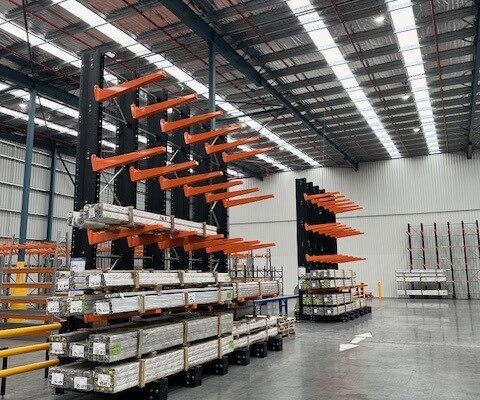
Two sets of cantilever racking in a warehouse. The cantilever racking is holding long spans of a material.

What Is Cantilever Racking?

Warehouse racking isn’t just all about pallet racking. There are different ways to store goods in warehousing, and one of these ways is with cantilever racking. When storing things in a warehouse, it’s important to use the right kind storage; the kind of storage that suits what’s being stored. For a lot of things stored in a warehouse, it’s often most convenient to store of those things on pallets, then it’s easiest to store those pallets on pallet racking. And there are different kinds of pallet racking that are designed for specific types of storage.

Cantilever racking is simply a type of racking designed for a specific task. That task is storing longer items.

What Is Cantilever Racking Used For?

As mentioned, cantilever racking is useful for storing long items like piping and lengths of wood. Pallet racking can be good for storing items of uniform size that fit into slots of specific heights and widths, but for other items, something else is needed.

Cantilever racking is designed with arms sticking out as cantilevers (hence the name), meaning that support struts don’t get in the way of storage. This allows for long items to be stored without support structures getting in the way, allowing items to come directly on and off the racking easily. In this way, forklifts can easily be used to store and remove items from the racking.

Any long item can be stored on cantilever racking easily. As already mentioned, it’s often good for piping or lumber, but it can also be used to store lengths of wire or rolls of carpeting. Basically any long item that wouldn’t fit on pallet racking or shelving.

Cantilever Racking Isn’t A Replacement For Shelving

Industrial shelving can be useful for storing items that are palletised or that may be too awkward to fit on pallet racking, but it’s different from cantilever racking. As mentioned, cantilever racking doesn’t have vertical support struts that get the way of storing longer items, meaning it’s perfect for longer items. Shelving, on the other hand, has vertical supports that make it difficult (if not impossible) to store long items.

With that in mind, cantilever racking also often lacks decking that allows for items of all lengths to be stored on it. A limitation of cantilever racking is that items need to be long enough to sit on the cantilever arms because there’s no support structure beneath them. In situations where items are too short or small, standard industrial shelving, or even general pallet racking may be a more suitable storage solution.

But Cantilever Racking Can Be Customised

All of this doesn’t mean that cantilever racking can’t be customised though.

One main customisation of cantilever racking is adjusting the heights between cantilever arms as well as the angle at which they’re mounted. For some items, having the arms completely horizontal is fine, but for other items like piping, it’s usually advisable to have the arms angled to prevent the piping from rolling off the racking.

Beyond that, cantilever racking can be further customised to allow it to support a variety of weights and lengths. Here at A1 Precision Solutions, we’ve even custom fabricated cantilever racking to have decking on it. This essentially creates very long space shelving that can be adapted to store items of various sizes and lengths.

Is Cantilever Racking Right For You?

Cantilever racking may be a good solution for your warehouse storage, but other solutions are also available.

In the world of warehouse storage, there are so many options, it’s often a good idea to talk to an expert. Because of this, get in touch with us to discuss your storage needs. We’re happy to help.
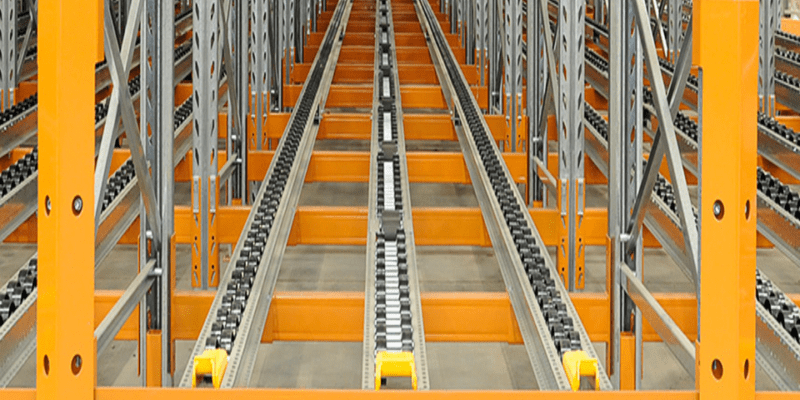
Close up of a pallet live storage system.

What Is Pallet Live Storage?

Different warehouse storage scenarios call for different types of pallet racking. Some situations need all pallet positions easily accessible, others need high density storage solutions.

Pallet live storage is a type of pallet racking that works well as a dense storage solution. What makes it unique from other dense pallet racking is that it’s loaded from the back and unloaded from the front. The pallet racking itself has runners on it, with the whole pallet racking system on a slight tilt to allow pallets to automatically move down the lanes. This makes pallet live storage much different from a lot of other dense pallet storage solutions, with its main advantage being a first in, first out storage system.

The Advantages Of Pallet Live Storage

As already mentioned, pallet live storage is a first in, first out storage solution. This makes it convenient for storing items that may be perishable or don’t have the kind of rotation that makes first in, last out multi-deep pallet storage acceptable. If you look at other multi-deep pallet storage, like push back pallet racking, you can store pallets as deep as is practical, but the pallets at the back are blocked in. Meanwhile, with pallet live storage, you can have pallets stored as deep as is practical, but the first pallets that went in are the most accessible.

The other advantage to pallet live storage’s first in, first out system is in safety. Since pallets are being loaded and one end of the pallet racking and unloaded on the other side of the pallet racking, materials handling equipment can stay in specific spaces while also limiting traffic because one area is designated as loading and one area is designated as unloading.

This safety advantage also makes pallet live storage a relatively quick storage solution. In conventional pallet racking, if a forklift driver looking to load a pallet onto racking near where another driver is unloading a pallet from racking, the first driver needs to wait. However, if these functions are happening in separate areas, this lower traffic allows workers to work faster.

Things To Consider With Pallet Live Storage

Although pallet live storage is a good choice of pallet racking for a lot of scenarios, it does tend to be more expensive than a lot of other forms of pallet racking. This is because pallet live storage literally has a lot of moving parts and is more complicated than pallet racking that simply holds pallets in place. It’s more complex, but can be worth it for the cost savings of increased storage density.

With that, although pallet live storage is dense, access to the front and back of the pallet racking is still needed, which may not be suitable in some warehouse situations. This, of course, also cuts on storage density by adding another aisle. This may be worthwhile if you need dense pallet storage that’s also first in, first out. It’s also worth considering that pallet live storage is fast.

Although pallet live storage has a lot of good use applications, especially where a warehouse may be storing many pallets of the same SKU, it’s also very useful in a crossing docking situation. When used at a cross dock, all of pallet live storage’s strengths come into effect with very few of its negatives. Since loading and unloading happen at different sides of the pallet racking, inbound goods are easily separated from outbound goods. Some of the selectivity issues often found in dense storage are also removed because rather than trying to keep pallets of the same SKU in the same row, each row of the pallet live storage can just be treated as a queue of pallets waiting for be dispatched.

Consider Pallet Live Storage For Your Warehouse

As with any kind of pallet racking, pallet live storage may be a good solution for your warehouse, or there may be a better solution. If you need advice on the best kind of pallet racking for your situation, please get in touch with us. We’re happy to help and provide advice.


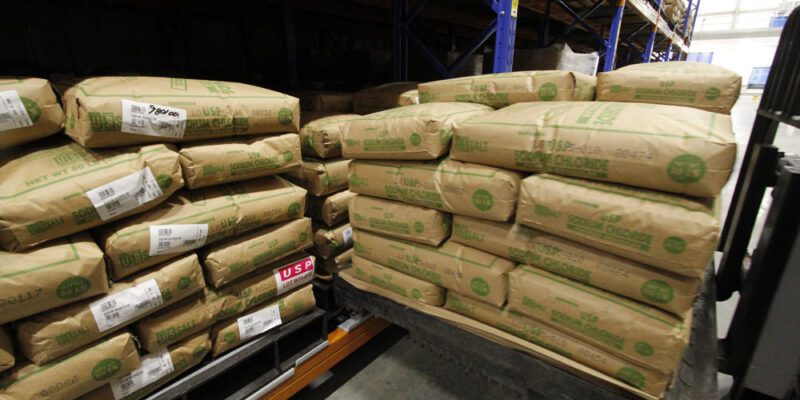
Forklift loading a pallet of sodium chloride bags on push back pallet racking.

What Is Push Back Pallet Racking?

Push back pallet racking is one of many different types of pallet racking that offers a storage solution unique to the needs of a given situation. When considering warehouse storage solutions, it’s important to use the right type of racking to suit storage needs, rather than adapt storage needs to suit racking. And push back pallet racking is one of these options.

Push back pallet racking allows for dense pallet storage by storing pallets multi-deep. In order to load the next pallet onto the racking, a forklift simply pushes the already loaded pallet back. When unloading, the racking is on a slight decline, allowing pallets in the back to slide forward. This makes push back pallet racking a good solution for dense pallet storage while also allowing for fast and easy pallet unloading. The other advantage here is that specialised forklifts don’t need to be used to load and unload push back pallet racking; they’re only require to be able to reach on pallet deep.

Since the pallets on push back racking easily slide forward or back as needed, there’s almost no limit to how deep pallets can be stored. The only limit comes to space and the ability of the forklift to push the racking. This gives the potential for very dense pallet storage.

Another advantage to push back pallet racking is that it can often be more selective than other forms of multi deep pallet racking like drive-in racking, which also allows for multi deep storage. However, drive-in pallet racking requires rows and columns to be cleared to access pallets at the back, meanwhile, push back pallet racking can clear one row at a time. This means that, although push back pallet racking usually works best with multiple pallets of the same SKU, those SKUs only need to share a single row of racking.

Drawbacks To Push Back Pallet Racking

As already mentioned, it’s important to use the right kind of racking for a particular storage situation. And there are  a lot of types of racking to choose from. What this means is that push back pallet racking isn’t always the best option. It’s good, solid racking, but should only be used in situations where it’s warranted.

The biggest drawback to push back pallet racking is that it’s first in, last out storage. Since pallets at the back get blocked in, everything needs to come out before the first loaded pallet comes out. This isn’t a problem in storage situations that don’t risk stock spoiling, or if there’s high enough stock rotation that it doesn’t matter, but it’s still something to consider.

That being said, lower selectivity and first in last out storage is common in most types of multi deep racking. So, while it’s a drawback when compared to selective pallet racking, it’s usually not a deal breaker for warehouses looking for dense storage.

Another concern with push back pallet racking is the storage of more fragile goods. Since pallets slide forward on the racking, very fragile goods may become damaged. Of course the racking is designed so that the pallets don’t slide too quickly, but pallets that contain goods that require an extreme amount of care may not be suitable for push back pallet racking.

Is Push Back Pallet Racking Right For You?

The type of pallet racking to use in your warehouse will depend on the exact storage situation at hand and what’s required. A lot of business choose to use a denser form of pallet racking in order to save on warehouse space, however, the exact kind of dense pallet racking will depend on the warehouse’s needs, how many pallets it has of each SKU, stock rotation, and more.

Push back pallet racking definitely should be considered if a dense storage solution is needed, but it’s also important to consider other solutions as well. But that’s where we come in. We’re happy to give you the advice you need to decide what racking is best. Contact us today.

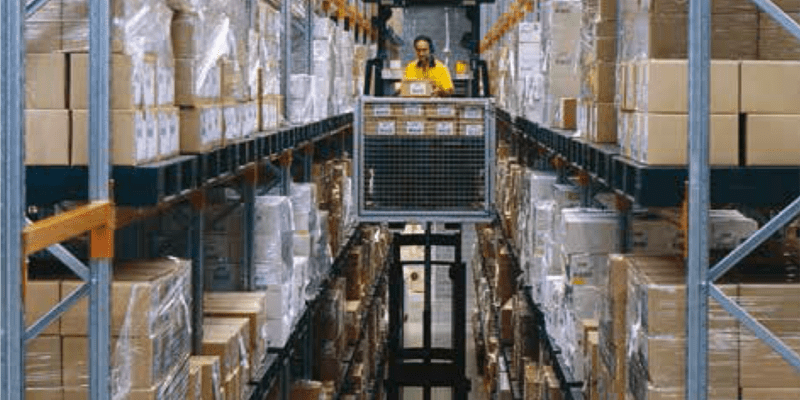
Narrow aisle pallet racking filled with pallets and boxes.

What Is Narrow Aisle Pallet Racking?

A big decision that often needs to be made when determining the right kind of pallet racking to use for a business is weighing up selectivity and storage density. With a lot of pallet racking, you can have easy access to all the pallets in the warehouse, but that comes at the cost of having more aisle space for pallet access. On the other hand, pallets can be stored multi-deep, eliminating the need for as many aisles, but this reduces selectivity because pallets become blocked in. For some products being stored in a warehouse, this trade off isn’t a problem. A warehouse that has only a couple pallets of each SKU needs the high selectivity, so they’re not concerned about density. A warehouse that has many pallets of the same SKU will be concerned about density, but won’t mind blocking in pallets of the same SKU.

There are situations, however, where both selectivity and density is needed. Warehouse space is expensive, so maximising the amount of pallets stored in a warehouse is desirable; increasing density without cutting back on selectivity can be great for a lot of businesses.

This is where narrow aisle pallet racking comes in.

Narrow aisle pallet racking is exactly what it sounds like. Narrow aisle pallet racking is made up of selective pallet racking, but with the rows closer together, making the aisles between those rows narrower. This means that less space in the warehouse is used for rows, freeing up that space to be used for racking. Aisle space between rows of racking is reduced by almost half, meaning that almost twice as much racking can fit into the same space, but pallets aren’t blocked in by pallets in front of them like with double deep pallet racking.

In this way, selective pallet racking allows for better pallet storage density while still being able to access every pallet in the warehouse easily.

Why Not Always Use Narrow Aisles In Warehouses?

The main drawback of narrow aisle pallet racking is that it requires specialised materials handling equipment to access pallets. Specialised forklifts, like turret trucks, are designed to fit in narrow aisles and be able to pick up pallets.

While this specialised MHE is, of course, easy enough to purchase for a warehouse, it’s just another type of equipment that needs to be purchased for a warehouse. Going further, forklifts are generally able to lift more weight because they are designed to be counterbalanced. Turret trucks and reach trucks don’t have this same kind of counterbalanced so can’t lift the same amount of weight safely.

Because the type of equipment needed to be used in narrow aisle pallet racking is limited by the weight it can lift, the types and amount of goods that can be stored on narrow aisle pallet racking is also limited.

However, for lighter goods, narrow aisle pallet racking can be a very good option because selectivity is maintained while increasing storage density.

Narrow Aisle Pallet Racking Is Also Customisable

Since narrow aisle pallet racking is essentially selective pallet racking spaced closer together, it is just as customisable as selective pallet racking. This means that the same simplicity of design that allows for things like modified bay height can created in narrow aisle pallet racking.

This makes narrow aisle pallet racking a good and versatile option for a lot of warehouse storage applications.

Find Out If Narrow Aisle Pallet Racking Is Right For Your Business

Narrow aisle pallet racking can be a good option for a lot of businesses, but it’s not perfect for any situation. Determining the right storage solution for a business relies on a lot of factors like what’s being stored, stock rotation, and the space available. We’re always happy to provide advice on the best storage solution. If you need that advice, feel free to get in touch.

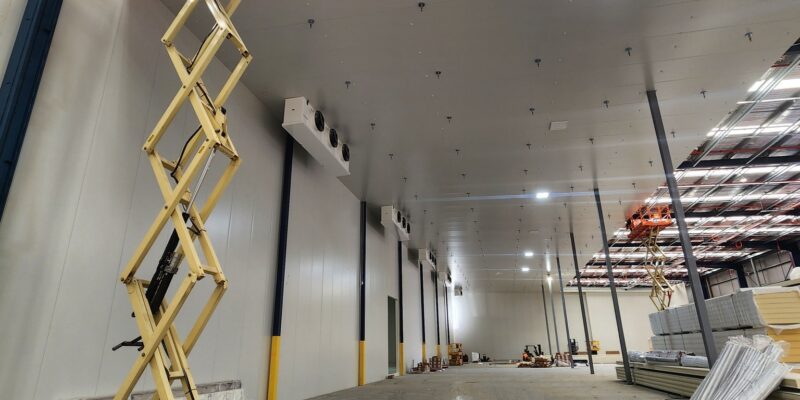
A large cold storage facility being built.

Cold Xpress Has Been Nominated For The MHD Sustainable Warehousing Award

Earlier this year, we announced the beginning of a major project with long time client Cold Xpress.

This project, which has been moving at a rapid pace towards completion throughout the year, will see the completion of Cold Xpress’ additional new cold storage facility built in Rowville, enlarging their footprint in the south east to just under 50,000 square metres of land area. This facility will have multiple temperature controlled zones for storage under chiller, freezer, and ambient conditions. Once completed, the facility will be able to accommodate up to 10,000 pallet positions of pallet racking. We here at A1 Precision Solutions are excited about it, and it’s been a pleasure to work with Cold Xpress on this fantastic project.

What makes us particularly proud is that Cold Xpress have recently become a finalist in the MHD Mercury Sustainable Warehousing Awards. From the beginning of this project, there’s been a clear business directive from the owners of Cold Xpress to create a long term plan to not only serve Australian businesses well, but also be environmentally friendly in the way their business operates. Cold Xpress’ commitment to innovation really shows in their new facility.

What Makes Cold Xpress’ New Facility So Green?

From the beginning of the project, the management team and owners of Cold Xpress have been challenging us to find environmentally friendly solutions to their new cold storage facility. We’re proud to be a solutions focused commercial construction company, and we rose to this challenge, despite cold storage often being very energy intensive.

The environmentally friendly credentials of this project come down to two major pillars: solar power and efficient refrigeration. Working together, we were able to reduce the need for drawing off grid power. The efficient, CO2 based, refrigeration has the added benefit of having other environmental benefits as well.

Looking just at the solar installation, this was an obvious renewable feature for the project, but the installation won’t be as simple as just putting some panels on the roof. In order to take the weight of the solar panels, our engineering team designed a way to reinforce the roof, allowing it to hold as many solar panels as needed for Cold Xpress’ new facility to operate. Once installed, these solar panels will allow Cold Xpress’ new facility to operate off renewable energy during the day; they have plans to install a battery solution for the night.

All that being said, we were able to save Cold Xpress on additional solar installations (or need to rely on grid power) through taking advantage of new technologies in refrigeration. Although it’s less widely used in Australia, CO2 based refrigeration systems have been getting increasingly adopted overseas due to their environmental credentials and ease of use. More lately, many businesses in Australia have begun to see the advantages of CO2 based refrigeration, and Cold Xpress is about to become one of them.

According to Hillphoenix, CO2 based refrigeration systems require smaller compressors to operate. Not only does this save on space, it also means that it saves on electricity. This is what has allowed us to lower the power requirements for the facility. Outside of electricity consumption, although CO2 isn’t often associated with being environmentally friendly or sustainable, in the world of refrigeration, it is. We all know that CO2 is a by-product of industrial processes, however, using it in refrigeration means we’re using a by-product for something useful rather than having it cause pollution. Traditional natural refrigerants like ammonia on the other hand need to be produced in industrial facilities. It may sound ironic, but the “carbon footprint” of using CO2 over ammonia in refrigeration is lower.

Beyond CO2 refrigeration being better for the environment, we also suggested that Cold Xpress use it simply because it will be easier for them to work with long term. Ammonia tends to be more regulated than CO2, meaning there are more safety regulations in place that need to be complied with. For example, although coolant leaks should be avoided and fixed as quickly as possible, when CO2 leaks, it can’t catch fire and it’s not considered toxic to breathe.

In addition to the environmentally friendly power and refrigeration, we’ve been sure to source insulated panels that have received approval from the Global GreenTag organisation. This accreditation ensures that the insulated panels used for the temperature controlled areas are made to the highest environmental and human rights standards possible.

Finally, the fire safety system also cut down on material use through a novel design. Due to cost requirements and sustainability concerns, we engaged a fire engineering firm to come up with a unique solution for the site. The existing sprinkler system normally would have to be replicated beneath the cold room ceiling, but the engineered solution we came up with meant that we could place heat detectors in the ceiling instead. This allowed the existing sprinkler set up to penetrate through the cold room ceiling and into the freezers and fridges. This not only kept the cost down, but it also saved on materials because a new system didn’t need to be manufactured.

There’s More To It Than Just A Sustainable Facility

Although we here at A1 Precision Solutions like to boast about how our innovative approach has helped a client achieve their business’ environmental goals, we have been impressed at how Cold Xpress do business. We were also surprised that they’ve found the more sustainable approach an easier way to operate.

For instance, Cold Xpress is transitioning to a fully paperless warehouse system. This shift not only supports environmental sustainability but also enhances efficiency by allowing quicker and easier access to administrative records through digital means. Their customers have already experienced the advantages of their online and digital transport operations. Now, Cold Xpress is completing the final phase of their digital transformation with the development of their paperless warehouse, spearheaded by their tech partner, XDOCK.

Another small sustainable feature of Cold Xpress’ new facility that’s easy to overlook is its location. The new facility sits next to an entrance to the Eastlink Freeway. Again, this may sound small, but it reduces the need for trucks to waste fuel sitting in traffic after they get off the freeway and onto surface roads; they can get on the freeway onto their destination quickly and efficiently. While of course this reduces fuel consumption, it also means faster service to Cold Xpress’ customers as well.

What’s Next In The Cold Xpress Project?

What’s next for this project is hopefully an award, but we’ll have to wait to find out.

In the meantime, the installation of the fire rated insulated panels is nearly complete. This will be followed by the preparation of concrete slab heating and insulation. This is a relatively large part of the project that will ensure the building’s foundations can withstand the very low temperatures of the freezer environments.

As the inside of the warehouse fit-out happens, we’ll also be building an outdoor plant room to accommodate the CO2 refrigeration equipment as well as an electrical substation for the roof solar and attachment to grid power as a backup.

From there, this project will also see an extension to the building loading docks to accommodate more truck traffic.

This project has been moving along quickly since its start, and it’s expected to finish well within schedule. We wish Cold Xpress luck with their award and congratulate them on their hard work.

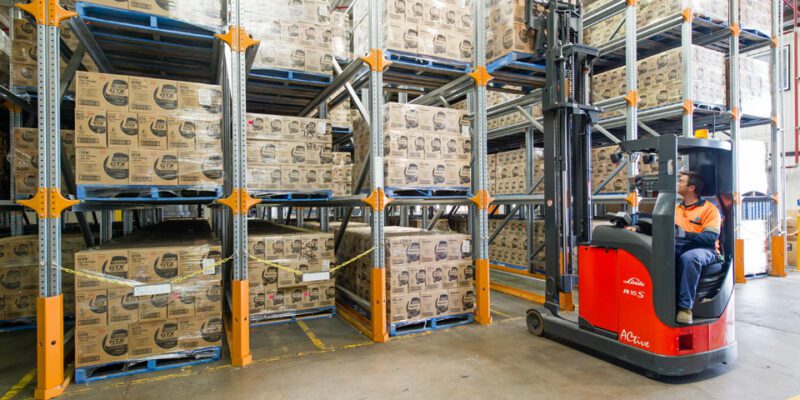
Forklift using drive in pallet racking.

What Is Drive-In Pallet Racking?

Warehouse storage has a lot of options.  There are a lot of options for material handling equipment, conveyors, space utilisation, and more. Once of the biggest choices to make in warehouse storage is when it comes to pallet racking. Pallet racking isn’t a one size fits all for all storage solutions. Instead, there are different kinds of pallet racking that do the job of pallet storage in very different ways.

Drive-in pallet racking is one of these types of pallet racking that works well for certain types of storage. As the name would suggest, drive-in racking is designed to be driven into by a forklift. This allows for storage to happen multiple pallets deep while also having retrieval be relatively fast through the use of a forklift.

Drive-In Pallet Racking Can Be Very Dense

The main advantage of drive-in pallet racking is that it can allow for very dense storage. Storage density can be critical in warehouse situations because it ensures that as much space as possible is being used in the warehouse. Since the depth of storage with drive-in pallet racking is almost limitless, it’s possible to waste very little space with drive-in pallet racking.

For storage situations where there are many pallets of the same SKU, this extra density can be extremely useful. Of course, this density means that pallets at the back of a row aren’t accessible, but this loss of selectivity may be worthwhile when it’s all the same thing being stored a lot.

Drive-In Pallet Racking Has Similar Advantages To Other Dense Racking Solutions

Like other dense forms of pallet racking like double deep pallet racking, drive-in racking has the same advantages (and disadvantages) of a dense storage system.

As mentioned, with most dense pallet racking like drive-in pallet racking, it works best when a warehouse is storing many pallets that have the same SKU and in situations where first in last out storage isn’t a problem. This is because pallets at the back are blocked in.

Where drive-in pallet racking really has an advantage over other dense storage systems is that it allows for relatively fast retrieval of pallets. Since all a forklift driver needs to do is drive straight into the pallet racking, retrieval is quick and easy. What this can mean is that although drive-in racking is a first in last out system, it works well in storage situations with relatively high stock rotation.

Value Versus Cost Is Great For Drive-In Pallet Racking

The more complex pallet racking gets, the more expensive it gets too. Although drive-in pallet racking is far from the most complicated pallet racking available it is, of course, more expensive than something simple like selective pallet racking.

However, despite the increased cost of drive-in pallet racking, it can still provide a lot of value. This is purely down to its density allowing more pallet storage in the same space when compared to other less dense racking solutions. Pallet racking is a one time cost, but rent for a warehouse is an ongoing cost. Sometimes it’s a better idea to spend a bit more at first to save on the ongoing cost of a bigger warehouse.

Find Out If Drive-In Pallet Racking Is Right For Your Business

Drive-in pallet racking has a lot of great use cases, especially when dense storage and fast storage is needed. One common use is in cold storage. Although cold storage facilities may need to rotate stock, cool rooms and other cold storage facilities can be expensive to own and operate, so space is always at a premium. It’s also important to move goods quickly within cold storage.

That being said, drive-in pallet racking is limited to cold storage applications.

If you’re in need of a denser storage solution, but you’re not sure what type of racking will work best for you, feel free to get in touch with us and we’ll be happy to help.