Office Extension

How To Prepare For An Office Make Good

When it’s time to leave a commercial premises, whether it’s an office, warehouse, or shop, the expectation with the landlord is that the building is returned back to its original state. This is what’s called a make good. Sometimes a make good is referred to as a commercial strip out; it’s all the same thing: it all refers to the actions a tenant needs to take at the end of a commercial lease.

What exactly needs to be done in the make good/strip out process will depend on what state the building was at the beginning of the lease as well as what is outlined in the contract. Some buildings are leased as just a shell, with no floor coverings, partitions, or false ceilings; often the expectation is to bring it back to base building at the end of the lease in a situation like this. Other time, a building may be leased with basic fittings, and the expectation is to still return things to their basic state. But situations do exist in a more “in between” state when it comes to make goods.

Since there are different situations, every commercial make good is different as well. But there are similarities too, and similar ways to get ready for your upcoming make good when you’re ending a commercial lease.

Speak To Your Landlord About Your Make Good Obligations

Generally speaking, what’s in the commercial lease is what is expected for the make good, but it’s always worthwhile speaking to your landlord before commencing any preparations for a strip out.

When speaking with the buildings’ owner, don’t expect them to want your business to keep the existing commercial fit-out, but also speak to them about what aspects of the fit-out may benefit them and can be saved (and safe you money). The existing fit-out in a commercial environment is unlikely to be suitable for the next tenant, so it’s unlikely the building owner will want to keep it, however, some smaller items may be beneficial to the landlord while saving the old tenant money on removal.

With this in mind, the premises may have originally been leased as a base building, but the landlord may be open to keeping a number things like floor and wall coverings. It’s worth speaking with the owner and negotiating exactly what needs to be done as part of the make good, even if it’s just to clarify contractual obligations. This will avoid conflict in the future.

Speak To Professional Early In The Process

Once the make good obligations are clarified, speak to a professional commercial builder about the project to get an estimate of how long the work will take. Engaging a professional early will ensure there are no delays in the make good project and also make sure that all parties involved in the project are aware of the scope, what needs to happen, and when it needs to happen.

A professional make good company can help with other aspects of vacating a commercial premises too, while also giving advice on the general make good process and how to work with your landlord for the best outcome. Involving a professional early can really help.

Make Sure You Have Time To Actually Vacate The Building

Keep in mind that the make good needs to be finished by the time your business is expected to end its lease. This means that the business, its people, and all of its furniture needs to be gone before the make good project starts. So, assuming your business is moving offices, the office relocation needs to be completed before the make good starts. So, for example, if it’s anticipated that the make good will take two weeks, your business needs to ensure that it’s moved out at least two weeks prior to the last day of the lease in order to ensure there is enough time for the make good to happen.

It seems like an obvious reminder, but remember that the business needs to work to a move out date that can be many days or weeks prior to the actual end of lease date. Allow plenty of extra time.

Enjoy Your New Location

Whether you’re moving your business because you’re expanding or because you’ve just found a better office somewhere else, it’s important to enjoy your new location. Here at A1 Precision Solutions, we can provide complete end to end business relocation services including the fit-out for the new location, the relocation of the old business’ furniture and other goods, and the make good of the old premises. Not only does this ensure that all aspects of the project happen on time, it also means that the business being moved only has one supplier they need to worry about during a business time.

If you have a relocation or make good coming up, feel free to get in touch to discuss the project.
Pallet Racking

What Is Warehouse Optimisation

Awhile ago we talked about tips to optimise your warehouse, but we didn’t go into exactly what warehouse optimisation is or why it’s important. The term “warehouse optimisation” is fairly obvious in what it means; it’s a warehouse that works as well as possible and it’s something warehouse owners and managers want. But let’s dive deeper into what warehouse optimisation is.

The important thing to realise here is that warehouses are more than just simple storage. Warehouses are the centre of many businesses. Warehouses not only store the goods that a business sells, they’re also responsible for receiving and shipping those goods. And getting goods shipping quickly is central to good customer service.

This is why having an optimised warehouse is important.

Warehouse Optimisation Has A Goal

It’s easy to say that warehouse optimisation is just trying to create the best possible warehouse for a business. While that’s the case, there’s more focus to that. Just trying to be “the best” doesn’t mean much if we don’t know what the best is.

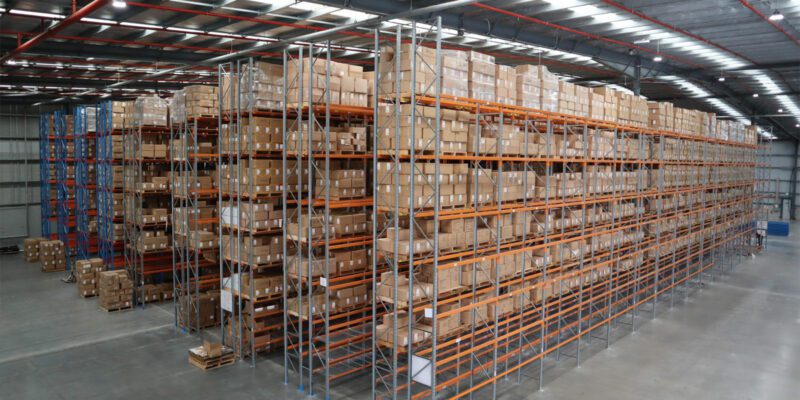
One thing warehouse utilisation looks at is space utilisation. Warehouse space can be expensive, so it’s important to ensure that it’s used effectively as possible. This means making sure there’s a good balance between any pallet racking storage density and selectivity; this will depend on what’s being stored, how many SKUs there are, and the throughput of the warehouse. A major part of warehouse optimisation is assessing space utilisation and how to improve it.

Warehouse optimisation also aims to improve inventory accuracy. Inventory accuracy is hugely important for the operation of a business. From a customer service point of view, having an accurate count of inventory makes sure customers get what they ordered. From a business operations point of view, having an accurate count of inventory stops overordering.

Warehouse optimisation also deals with optimal workforce levels. Understanding how many people are needed in a warehouse to keep it operating not only helps make sure the warehouse actually works, but it keeps budgets in check too.

An example that uses all of these factors in warehouse efficiency is picking time. How long it takes to pick an item depends on how the warehouse is laid out, how different SKUs are stored on pallet racking or shelving, how easy the item is to find, and the workforce available to find it. Improving one of these things can improve picking time.

But Warehouse Optimisation Is About Making Everything Work Together

Although in the picking example we saw that improving just one thing could be a big help, great warehouse optimisation looks to understand how multiple parts of warehouse workflow can work together to create even larger improvements in warehouse efficiency.

A good warehouse optimisation plan looks at the operational aspects of a warehouse and the functional aspects of a warehouse. The operational aspects of a warehouse include the picking and packing, shipping, receiving and more; these are the core parts of what makes a warehouse what it is. The functional aspects of a warehouse include the layout, technology, types of storage, and the warehouse; while this is away the core of the warehouse, you still can’t have a warehouse without these things.

So, in the example of improving picking time, rearranging a warehouse to make it so that more popular items are closer to packing areas may be a good way to reduce travel time for picking, but how does this affect the storage of other items? How does this new layout affect the movement of forklifts throughout the warehouse? Was this space previously used to process returns and will you lose inventory accuracy now that it can’t be processed properly?

Of Course There’s No Single Answer

None of these questions have a single answer, and there’s never a single simple answer to warehouse optimisation. This is because every warehouse is different and every business and its needs are different. There are best practices that can usually be used across different situations, but ultimately optimising a warehouse well means coming at it as a unique challenge.

There are a lot of factors that go into warehouse optimisation, and it takes a professional to understand what needs to get done. Feel free to get in touch if you’d like advice on your warehouse.

Installation of sandwich panels in a cool room.

How Do Insulated Sandwich Panels Work?

Insulated sandwich panels have a lot of uses in construction. One main use is in the construction of cool rooms and freezer rooms, but they are useful beyond that as well. Beyond their general use for insulation, whether that’s sound or temperature insulation, in all sorts of building types, insulated sandwich panels work well in any situation where thermal insulation is needed. As already mentioned, insulation is useful in a general sense, but beyond being need in cold storage, it may also be needed to generally control and regulate temperature in processing facilities for food and even pharmaceuticals.

So it’s clear that insulated sandwich panels have a lot of uses.

Insulated Sandwich Panel Construction

Insulated sandwich panels are typically constructed of an insulator core with a metal or polymer outside. The insulator is sandwich between the outside layers, which is where the name “sandwich panel” comes from. The outside of the panel provides most of the strength and rigidity to the panel while the insulator provides insulation.

The insulator on the inside of a sandwich panel is usually made of polyurethane, polyisocyanurate, expand polystyrene, or mineral wool. All of these materials are generally good insulators, but they each have their pros and their cons, and they all have their uses based on how much insulation is needed, their exact use case, budget, and more. With this, the size and thickness of sandwich panels will vary depending on their use. A higher amount of insulation will obviously need a thicker panel, even if its insulating core is extremely efficient.

For example, mineral wool panels tend to have good fire resistance, and are usually used in situations where risk of fire is higher. The trade off with mineral wool, though, is that panels made from it tend to be more expensive than other materials. On the other hand, expanded polystyrene sandwich panels tend to be less expensive than other materials, but don’t have the higher insulation rating of other types of sandwich panels.

Why Use Insulated Sandwich Panels?

Insulated sandwich panels can make construction extremely fast and easy.

In a situation, for example, where a cool room needs to be built in a warehouse, it’s often faster and easier to build with insulated sandwich panels than it is to attempt to built walls and other partitions with enough insulation to do the job. Basically speaking, insulated sandwich panels are designed to be a partition and an insulator all in one.

Insulated sandwich panels are also designed to fit together easily during construction. What this means is that the construction of a facility, such as a cool room or processing facility, using sandwich panels is generally faster and easier. Since the panels themselves are efficient, it can also lead to an overall reduced need for materials as well. All of this combines to bring down costs in terms of both labour and supplies.

Of course, insulated sandwich panels don’t have the same load bearing capabilities as other construction materials, but they’re not meant to.

Insulated Sandwich Panels Work Like Any Other Insulator

There’s nothing special about insulated sandwich panels other than the fact that they’re designed and engineered to be great insulators while also being quick and easy to build with in situations where insultation is needed. Typically the insulation we’re talking about is thermal insulation, but they can also work well for soundproofing, protection again moisture, and in situations where building materials need to be fire resistant. It all depends on what the core and the outer materials are made of.

Since insulated sandwich panels are so varied, it’s usually best to work with an expert on what type of sandwich panel would be best for a particular project. This is where we can help. If you have a project coming up that needs some sort of insulation, feel free to get in touch. We’re happy to help.

Racking protection

The Importance And Benefits Of Pallet Racking Protection

When storing goods on pallets in a warehouse, pallet racking becomes one of the most important assets of that warehouse. Pallet racking is an extremely important tool for warehouses that makes it easier and more efficient to store goods. It’s also an expensive outlay when fitting out a new warehouse. Because of this, it’s important that it lasts and avoids damage.

This is where pallet racking protection comes in.

Although it’s not mandatory, we always suggest pallet racking protection whenever we’re supplying or professionally installing pallet racking for a business. It’s an additional cost, of course, but the benefits from the pallet racking far outweigh this small cost when compared to the pallet racking.

Pallet Racking Protection Prevents Damage To Pallet Racking

This almost goes without saying, of course, but it’s worth highlighting what damage protection actually means.

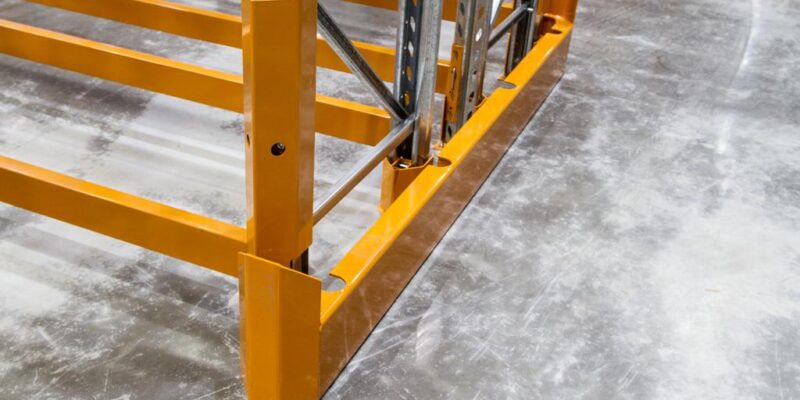
Pallet racking is usually damaged due to collisions with manual handling equipment, typically forklifts. Even experienced and careful forklift drivers can make mistakes and the occasional collision is unavoidable. And, of course, these collisions can lead to damage. Damage can also happen from pallets or even heavy goods sliding on the floor and hitting it. There are a lot of things that can go wrong in a warehouse.

With the right pallet racking protection in place, any damage is confined to the protection, and not the pallet racking uprights and beams themselves. This means that it’s just a simple matter of replacing the pallet racking protection, not the damaged pallet racking components.

This Ultimately Saves Time And Money

Although pallet racking protection may need to be replaced because of a damage causing event, this is usually faster and less expensive than replacing or repairing a structurally critical pallet racking component. Pallet racking protection also ensures that damage usually isn’t so bad that the pallet racking can’t be used anymore; it minimising pallet racking downtime due to damage.

While it may be tempting to try and just live with any pallet racking damage, ultimately it’s dangerous and it will be picked up in an annual pallet racking inspection. And when the damage is noticed in an inspection, it will need to get fixed. Again, fixing/replacing pallet racking protection is less expensive than replacing the racking itself.

Going further, if pallet racking collapses, goods can be damaged and the warehouse can be slowed down or shut down during clean up. This loss of goods and productivity costs money.

Yes, when buying new pallet racking, the addition of pallet racking protection may be an unwanted expense, but it will ultimately pay for itself in savings over time.

Pallet Racking Protection Is Good For Safety

Most importantly, pallet racking protection is a safety issue. If a collision with pallet racking occurs, it can fall immediately if not properly protected. Collapsing pallet racking is a significant safety issue that can hurt or kill multiple people working in a warehouse. As already mentioned, pallet racking protection can limit the damage and prevent a sudden collapse.

Another safety benefit to pallet racking protection is that it works as another reminder to be safe. Safety equipment often serves two purposes: it prevents accidents while also being a visible safety reminder. And pallet racking protection does this too. Seeing pallet racking protection may help remind forklifts drivers to take care around corners and the end of racking rows, for example.

There Are A Lot Of Pallet Racking Protection Options

Pallet racking protection comes in different shapes and sizes and there are different options for different warehouse configurations. If you’re setting up a new warehouse, we’re happy to advise on the type of pallet racking portion that may be required. Alternatively, if you have an existing warehouse and need to install pallet racking protection, we’re also happy to help here.

double deep pallet racking.

Weighing Up Density And Selectivity In Pallet Racking

When it comes to pallet racking, there’s a lot of variety and different designs. These different types of pallet racking are designed to be used in different ways. Some aspects of the design differences are just for how pallets will be handled, but many of the design differences balance out selectivity and storage density.

Ultimately, different types of pallet racking balance selectivity with storage density. Generally speaking, pallet racking with a higher storage density is going to be less selective, and vice versa. If you think of pallet racking as a tool, it’s easy to see that, like many tools, different types of tools have pros and cons, and this the case in balancing the selectivity and the storage density of a particular type of pallet racking.

What Is Selectivity In Pallet Racking?

Selectivity refers to having easy and direct access to different pallets. The simplest form of pallet racking, selective pallet racking, gets its name from the fact that there’s direct access to every pallet being stored on it. However, selective pallet racking isn’t very dense. In order to have access to every pallet position, there needs to be aisles for every pallet position that are accessible via forklift.

Double deep pallet racking increases density, but half the pallet positions are inaccessible because they’re blocked by the pallet in front. Double deep pallet racking is still considered highly selective, but not quite as much as selective pallet racking. In double deep pallet racking, however, pallets of the same SKU are stored in front of each other, so while selectivity is diminished, it’s still possible to get access to every type of product in the warehouse.

From this is can be seen that high selectivity pallet racking is good for warehouse storage situations where there is a large variety of SKUs compared to how many pallets there are of each SKU. This ensures that there’s access to every SKU, but, of course, the amount of pallet positions that can be fit into a given warehouse is reduced.

Beyond selective pallet racking and double deep pallet racking, narrow aisle pallet racking is also highly selective while also increasing storage density. As the name would suggest, narrow aisle pallet racking reduces the width of aisles between selective pallet racking, thereby increasing the storage density. The disadvantage to narrow aisle pallet racking is that specialised materials handling equipment is needed to retrieve pallets, but this could be a good trade off in situations where the density is needed as well as the selectivity.

What Is Storage Density In Pallet Racking?

We’ve already touched on it, but pallet racking with a higher storage density maximises the amount of storage space of the pallet racking and therefore the warehouse. To achieve a higher storage density, higher density pallet racking typically stores pallets multi-deep. High density pallet racking may store pallets 4-6 pallets deep, but there’s also really no limit on how deep the storage system can go.

When storing things multiple pallets deep, all the pallets are the same SKU. So, like with double deep pallet racking, there is still access to each SKU, but some pallets of a particular SKU are blocked in. With a lot of higher density pallet racking solutions a first in, last out system is in place because the pallets at the back of a multi-deep storage system can’t come out until the others in front of it are moved. However, there are solutions, like pallet live storage that allow for high density storage while still being first in, first out. Again though, even when trying to achieve very high storage density, it’s a trade off between the highest possible storage density and being able to get to specific pallets when needed.

Because of all of this, higher density, multi-deep pallet storage solutions are generally best suited to situations where there are many pallets of the same SKU compared to the total amount of SKUs being stored. This way all the pallets of the same SKU can be stored in the same row.

Apart from pallet live storage, high density pallet racking also includes types like drive-in pallet racking, which allows forklifts to drive all the way into the pallet racking to store pallets multi-deep. Push back pallet racking is another higher density storage solution that stores pallets on an inclined plane so that they can be pushed back and then slide forward when the pallet in front is removed.

The Best Option Will Depend On Your Business Needs

There’s no one size fits all solution for pallet storage. The exact solution will depend on what a particular business is storing, how much storage they have, the amount of SKUs they have, how much stock rotation is needed, and more.

While it’s likely a good to have an idea of what’s needed in terms of storage, ultimately businesses should speak to an expert about their pallet storage needs, and we’re happy to help.

Class 7 Cleanroom Construction

What’s Involved In A Warehouse Fit-Out?

When moving into a new warehouse, it’s often a blank space that needs to be turned into something. This is where a warehouse fit-out comes in. The warehouse fit-out process is simply getting it fit for purpose, whatever that purpose may be.

But although there are similarities between all warehouses and their fit-outs, different warehouses are used for different things, so there will also be differences in each warehouse fit-out and what’s involved.

Let’s take a look at some of the things that are typically involved in a warehouse fit-out as well as some things that are often involved in a warehouse fit-out, but may not occur with every warehouse fit-out.

What’s Involved In Most Warehouse Fit-Outs?

Warehouses are used in such versatile ways, it’s hard to say what’s always part of a warehouse fit-out, but there are certain things that are part of a warehouse fit-out, at least most of the time.

Pallet Racking And Shelving

Pallet racking is usually a major part of a warehouse fit-out. This is because pallet racking is a convenient storage method in a warehouse setting. While not every warehouse is going to require some form of pallet racking, in our opinion, pallet racking is usually needed, at least in small amounts. Of course if a warehouse is storing things that have not been palletised, then pallet racking likely isn’t needed. However, shelving often is needed instead.

Basically speaking, pallet racking or shelving is often installed in warehouses and it’s part of the fit-out process. At the very least, some sort of storage solution needs to be installed as part of a warehouse fit-out. What that storage solution is will depend on what’s being storage in the warehouse.

Materials Handling Equipment

Just like with pallet racking, materials handling equipment is usually required in a warehouse situation, but the exact type of MHE will depend on what the warehouse is being used for. In common warehouse situations that use pallet racking, the warehouse will need one or more forklifts as well as areas storing and charging the forklifts. This is the same for any other type of materials handling equipment.

If the warehouse requires equipment like conveyors, the fit-out, of course, will include installing that equipment as well.

Safety Systems And Line Markings

Safety is the most important part of any workplace, especially warehouses. And because of this, making a warehouse safe is an important part of the fit-out process. Even a smaller warehouse fit-out will have a safety consideration to it.

These considerations and designs may include installing line markings and safety barriers throughout the warehouse. It may also include safety signage, mirrors, damage protection for pallet racking and other equipment, and more.

Although each warehouse fit-out can be different, all of them include installing some sort of safety measure.

Other Aspects Of A Warehouse Fit-Out

As mentioned, different warehouses are used for different purposes, so the fit-out may be different depending on what the warehouse is going to be used for. While the following examples aren’t installed into every warehouse, they’re things that are often required.

Mezzanine Levels

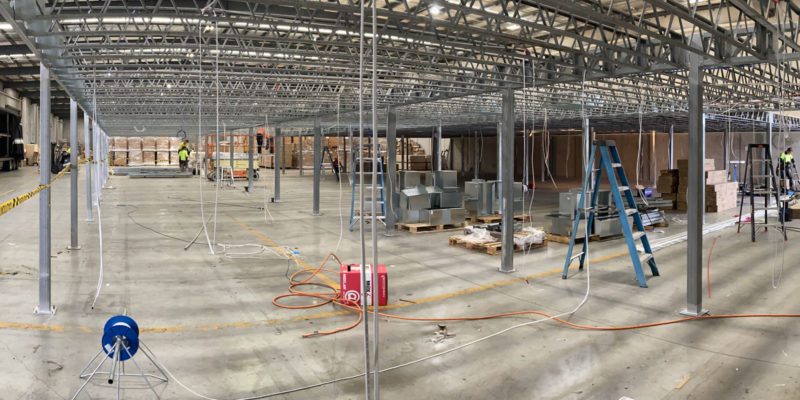
A common part of a warehouse fit-out is installing a mezzanine level for additional storage or some other use. Mezzanine levels and raised storage floors have a variety of uses and can incorporate pallet racking, shelving, and even office space. Some warehouses will incorporate a mezzanine level or raised storage area above a break area, packing area, or equipment storage area; this way the storage of goods isn’t “lost” to something else.

Warehouse Office Space

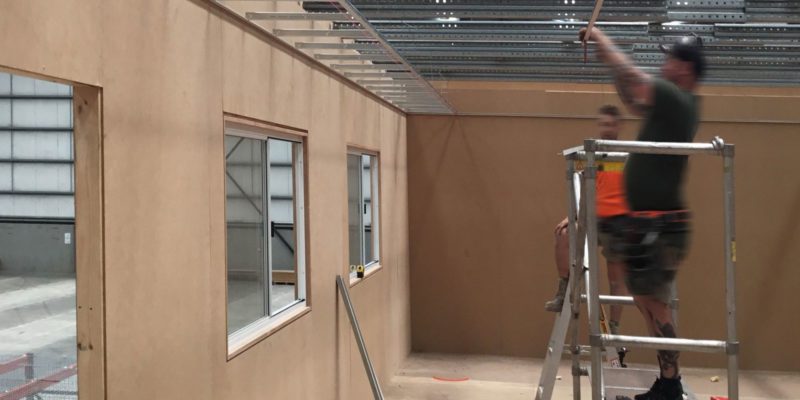
Some warehouses come with a dedicated office area, others are completely empty areas that may need one built whether on the warehouse floor or as a mezzanine. So, in this way, an office fit-out is often part of the warehouse fit-out process.

Obviously the size of the office and what’s included in its fit-out will depend on the nature of the business. The office portion of a warehouse could be as small as a single room with a desk all the way up to a large open planned office with multiple private offices and meeting rooms.

Cool Rooms And Clean Rooms

If a business will be storing food or any other perishable goods, they may require a cool room or freezer room to be installed as part of the warehouse. This may be a substantial part of the warehouse or only a small portion of it. Either way, it’s not uncommon to incorporate a cool room into a warehouse.

Similarly, some warehouses may install a clean room. Clean rooms can be needed for reasons ranging from highly sophisticated medical processing and manufacture to computer components. Of course this isn’t needed for every warehouse, but clean rooms and cool rooms are not unusual in a warehouse fit-out.

All Warehouse Fit-Outs Are Different

Every warehouse fit-out is different because every warehouse is used for something different. While there are similarities between warehouse fit-outs, it’s important to approach each one appreciating that it’s unique. If you’re looking to move your business to a new warehouse, feel free to get in touch to discuss your needs.